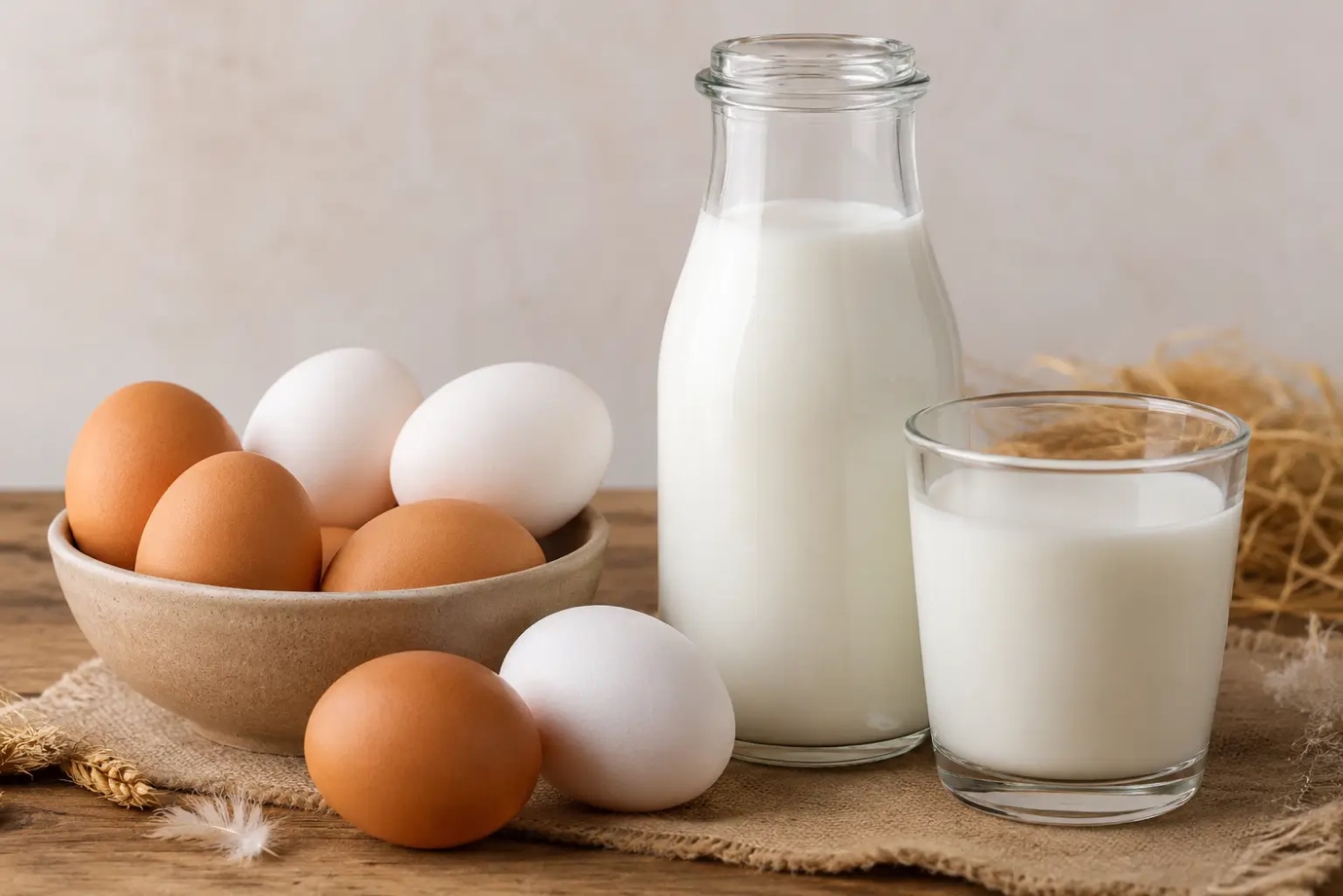
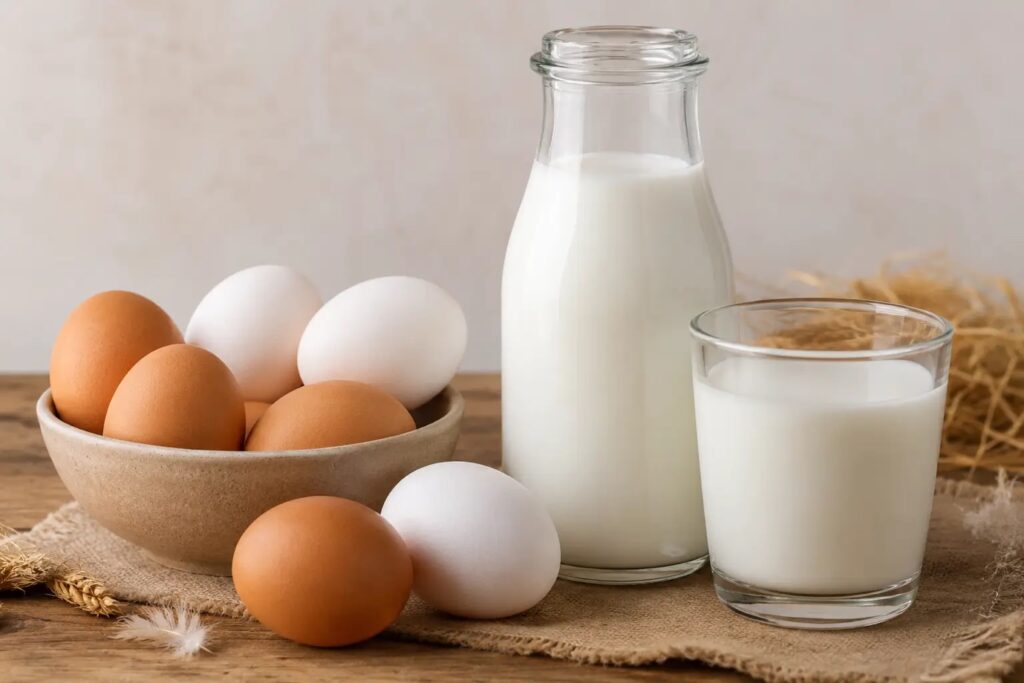
Milk is vegetarian. Eggs are non-vegetarian.
It’s one of those food rules we grow up accepting without ever really asking why.
In India, the distinction feels almost instinctive:
Paneer? Vegetarian.
Curd? Vegetarian.
Ghee? Vegetarian.
Eggs? Non-vegetarian.
But pause for a moment.
Why are we so certain?
If vegetarianism is fundamentally about not eating the flesh of animals or killing animals for food, then perhaps the usual classification deserves a second look.
Because when we look beyond the plate and examine how milk and eggs actually come into existence, something rather curious emerges:
An unfertilised egg may have a stronger claim to being called vegetarian than milk.
And that might make us rethink what we have always been taught about both.
Let’s take a closer look.
First, an egg isn’t a chicken
It sounds obvious, but this is where the conversation needs to begin.
A chicken is an animal. Chicken meat is the flesh of that animal.
An egg is something entirely different — it is a natural reproductive product produced by a hen.
And the eggs we buy and eat are, in most cases, unfertilised. There is no developing chick inside, no embryo, and no baby chicken waiting to hatch.
A hen doesn’t need to be pregnant to lay an unfertilised egg. She naturally produces eggs as part of her reproductive cycle, whether or not a rooster is present.
So when we eat an unfertilised egg, we aren’t eating the animal. We’re eating something the animal naturally produces.
That distinction is important.
Now, let’s put the egg next to milk — another food that an animal naturally produces — and see where the comparison takes us.
Milk is also something an animal produces — but there’s a catch
Milk, like an egg, is something an animal naturally produces.
But there is an important difference.
Mammals produce milk to nourish their young. A cow doesn’t lactate because humans need milk for their morning chai, coffee, paneer or butter. She produces it because she has given birth and her calf needs to be fed.
For a dairy system to keep producing milk, this natural cycle has to continue. In commercial dairy production, that generally means breeding cows, pregnancy, giving birth and lactation — followed by another reproductive cycle once milk production declines.
And this is the part of the story we rarely see when we simply put a “vegetarian” label on a carton of milk.
We see the milk.
We don’t always see the pregnancy that made it possible, the calf it was meant for, or what happens next.
The calf comes first
There is a simple biological fact we often overlook: a cow produces milk to nourish her calf.
That is what her body is designed to do.
In dairy production, however, that milk becomes a commercial product for human consumption. How much milk the calf receives, how long it stays with its mother, and whether they are separated varies considerably across farming systems.
But the fundamental question remains:
When we take milk from a mother, what happens to the animal the milk was naturally meant for?
And once we ask that question, another — perhaps more uncomfortable — question follows.
What happens to the male calf?
There is another part of the dairy story that rarely makes it to the carton.
A female calf may eventually grow into a dairy cow and produce milk. A male calf, however, cannot.
This creates a difficult reality for dairy farming: what happens to an animal that cannot contribute to milk production?
The answer varies widely depending on the farming system, region and economics. Male calves may be raised for meat, sold, kept for other purposes, or, in some systems, euthanised because maintaining them has little economic value.
This isn’t an accusation against every dairy farmer, nor is every dairy farm operated in the same way.
It is simply a question worth asking when we automatically assume that milk is the more compassionate choice:
What happens to the animals that the dairy system doesn’t need?
Once we start looking beyond the glass of milk and at the entire production cycle, the idea that milk is inherently the more humane choice becomes much harder to take for granted.
Now look at the egg again
Now let’s come back to the egg.
A hen can lay an unfertilised egg without ever being pregnant. No rooster is required, no chick is developing inside it, and there is no baby animal that needs that particular egg for nourishment.
And most importantly, an unfertilised egg will never become a chicken.
So if we define vegetarianism as:
“Food that does not involve eating the flesh of an animal,”
then an egg clearly fits that definition.
And if we go one step further and define it as:
“Food obtained without killing an animal,”
an unfertilised egg can fit that definition too.
That doesn’t mean the egg industry is automatically cruelty-free. It isn’t. Intensive egg production can raise serious animal-welfare concerns, from confinement and overcrowding to the treatment of male chicks.
But that is a question of how the egg is produced, not whether the egg itself is vegetarian or non-vegetarian.
And if we’re going to apply that distinction to eggs, we should be willing to apply the same scrutiny to dairy.
Perhaps the real question isn’t whether an egg is vegetarian — but why milk gets a free pass.
So which one deserves the vegetarian label?
If we’re talking about traditional Indian dietary convention, the answer is straightforward:
Milk is vegetarian. Eggs are not.
But what happens when we put tradition aside for a moment and ask a different question:
Which of the two has the stronger biological and ethical case for being considered vegetarian?
That’s where things get interesting.
An unfertilised egg has a surprisingly strong case.
It isn’t meat.
It doesn’t require the hen to become pregnant.
It doesn’t take nourishment away from a newborn animal.
And the egg itself can be collected without killing the hen – unless you’re the farmer from The Goose That Laid the Golden Eggs — pun intended!
Milk, on the other hand, exists because a mammal has given birth and is producing nourishment for her offspring. Commercial dairy production can involve repeated breeding and pregnancies, separation of calves from their mothers, and difficult outcomes for animals that have little or no economic value to the dairy system.
Neither system is automatically cruelty-free. But if we’re going to judge foods by their relationship with animal life, it’s difficult to argue that milk should automatically receive a vegetarian pass while an unfertilised egg is rejected outright.
Perhaps we’ve been looking at the question backwards.
Instead of asking:
“Why are eggs non-vegetarian?”
Maybe we should be asking:
“Why do we automatically consider milk vegetarian?”
And once you ask that question, the conversation gets a lot more interesting.
This doesn’t mean eggs are automatically cruelty-free
Calling an egg vegetarian doesn’t automatically make it ethical.
How the egg is produced matters just as much as what the egg actually is.
The egg industry has its own serious animal-welfare concerns. Hens may be kept in cramped cages or intensive farming systems, and the treatment of male chicks has long raised ethical questions.
So if animal welfare matters to us, the conversation shouldn’t end with “vegetarian” or “non-vegetarian.”
We should be asking better questions.
Where did the eggs come from? How were the hens raised? Were they confined or allowed to move freely? What welfare standards does the farm follow?
And we should ask exactly the same questions about milk.
How was the cow treated?
How often was she bred?
What happened to her calf?
What happened to the male calves?
And what happens to her when she is no longer productive?
Because a vegetarian label only tells us what category we’ve put a food into. It tells us very little about the welfare of the animal that produced it.
Perhaps instead of simply asking whether our food is vegetarian, we should also be asking:
How did it reach our plate?
Perhaps “vegetarian” needs a rethink
Maybe we’ve made vegetarianism a little too simple.
Green dot.
Red dot.
Vegetarian.
Non-vegetarian.
A neat label on a packet. A quick answer on a menu.
But the food systems behind those labels are far more complicated.
If the idea is to avoid eating the flesh of animals, then an unfertilised egg deserves a serious conversation.
If the goal is to reduce animal suffering, then dairy deserves just as much scrutiny — perhaps even more than we traditionally give it.
And if the goal is to avoid all animal-derived foods and products, then neither milk nor eggs belongs on the plate.
That approach already has a name:
Vegan.
Perhaps the real lesson is that we shouldn’t judge a food solely by the dot on the packet.
We should also ask where it came from, how it was produced, and what happened to the animal behind it.
The Curious Wok Take
For generations, we’ve been taught a simple rule:
Milk is vegetarian.
Eggs are not.
But perhaps it’s time to ask a more fundamental question:
What actually makes a food vegetarian?
If vegetarian means not eating the flesh of an animal, then an unfertilised egg isn’t meat.
If it means not killing an animal for food, then an unfertilised egg has an even stronger case.
And if animal welfare is part of the conversation, then perhaps we need to look much more closely at dairy than we traditionally have.
Because behind a glass of milk is a reproductive cycle.
A mother.
A calf.
A system built around producing milk for human consumption.
Behind an unfertilised egg is a hen doing something hens naturally do.
Of course, neither dairy nor egg production is automatically cruelty-free. Both industries have serious animal-welfare questions that deserve attention.
But perhaps we’ve been too quick to reject the egg simply because we have been conditioned to call it “non-vegetarian.”
Maybe the more interesting food myth isn’t:
“Eggs can’t be vegetarian.”
Maybe it’s:
“Milk is automatically harmless because we’ve always called it vegetarian.”
And perhaps that’s the conversation we should be putting on the table.
Because sometimes, the most interesting food questions are the ones we’ve never thought to ask.
— The Curious Wok
What do you think?
If an unfertilised egg isn’t meat, doesn’t contain a developing chick and doesn’t require a hen to become pregnant, does it really make sense to call it non-vegetarian?
And if milk production involves pregnancy, birth and, in many dairy systems, separation of mothers and calves, should milk automatically get a vegetarian pass?
Maybe it’s time to look beyond the labels we’ve grown up with and question what they actually mean.
So, where do you stand?
🥚 Eggs should be considered vegetarian
🥛 Milk should remain vegetarian
🌱 Neither should be considered vegetarian
The question is on the table. What’s your take?